For a high-quality finish on sealed hard floors at home or at work, we recommend one of two systems: a Sabco microfibre round mop on an aluminium handle with a wringer bucket and a pH-neutral cleaner such as Supastar, or a flat mop system such as the Edco Duop set. For small areas, a White Magic spin mop is the lighter option. Check the flooring manufacturer’s care instructions first, then match the mop and cleaner to the job.
Before buying, identify the floor properly. Timber, laminate and timber-look vinyl can look similar but have different care requirements. A photo helps with the conversation; the flooring brand, product name or installer’s care sheet is better.
Start with the surface and the job
| Floor or cleaning task | What to look for | What to check first |
|---|---|---|
| Sealed timber or laminate | A microfibre mop, a pH-neutral cleaner and a method that controls moisture | The manufacturer’s care instructions and the type of finish |
| Smooth vinyl or ceramic tile | A round or flat microfibre mop that keeps even contact and rinses easily | Cleaner compatibility and any limits on water use |
| Textured flooring or recessed grout | A tool that can reach the soil, potentially a separate suitable brush | Whether the mop alone can clean the texture without excessive effort |
| Routine dust and hair removal | A suitable dry dusting pad or vacuum floor tool | That the tool is clean and suitable for the surface |
| Several rooms with different uses | Colour-coded mops and buckets, one colour per area | A clear system for identifying where each one is used |
Always check the floor’s finish and the manufacturer’s instructions before you start.
Cotton, microfibre or polyester: what’s the head for?
- Microfibre picks up more dirt and moisture per pass, is lighter to use and, in the Sabco round mop below, machine washable. It is our first recommendation for routine mopping.
- Cotton is absorbent and hardwearing, and it is the traditional choice with a wringer bucket. We stock Edco Tuff mops and the Sabco Contractor mop, and at the premium end the Sabco Ultimate ProClean cotton blend, alongside the Oates Duraclean mop head, a synthetic blend built for heavy commercial use.
- Polyester, usually blended with cotton such as the Oates Polyester Cotton Mop Refill, is not for everyday mopping. It is built for applying sealer and polish during a strip-and-seal, and it resists lint and abrasion on rough surfaces. We will publish a separate article on strip-and-seal soon.
Our first recommendation: microfibre round mop and wringer bucket
For a high-quality finish in homes and businesses, this is the system we recommend. We recommend microfibre over a cotton mop.
- Mop: the Sabco Premium Grade Microfibre Round Mop is 100% microfibre with a looped, banded tail that resists tangling. It can be used wet or dry, it is machine washable, and it comes in blue, green, red and yellow. An adaptor to suit 25mm wooden or metal handles is included.
- Handle: an aluminium handle from Oates, Sabco or Edco, such as our 1.5m aluminium contractor handle, which comes in a colour-coded range.
- Bucket: a traditional wringer mop bucket from Edco, Oates, Sabco or Pullman, such as the Edco 15 litre wringer bucket, available in five colours. See all mop buckets.
- Cleaner: a pH-neutral floor cleaner, as below.
Choose a pH-neutral floor cleaner
- Supastar is our premium recommendation, and the one we reach for on sealed timber. It is a pH 7, no-rinse concentrate, and its listing also covers vinyl, marble, terrazzo, slate and ceramic tile. Use about half a cap to one cap in a mop bucket of cold water. The label gives stronger mixes for heavier soiling, from 1:80 up to 1:20, so read it before tackling a build-up. Also available in 5 litres and 15 litres.
- Floor Master is a highly concentrated, low-foaming neutral detergent that works in a mop and bucket as well as in auto scrubbers. Also available in 15 litres.
- Agar pH-7 Neutral Detergent is a neutral, no-rinse cleaner with a citrus scent.
Follow the label dilution for Floor Master and Agar pH-7. A pH-neutral cleaner is for everyday mopping. Heavy soiling, built-up grime or degreasing needs a different product, so contact us or browse our heavy duty cleaners before you reach for more of the neutral cleaner.
Our second recommendation: a flat mop system
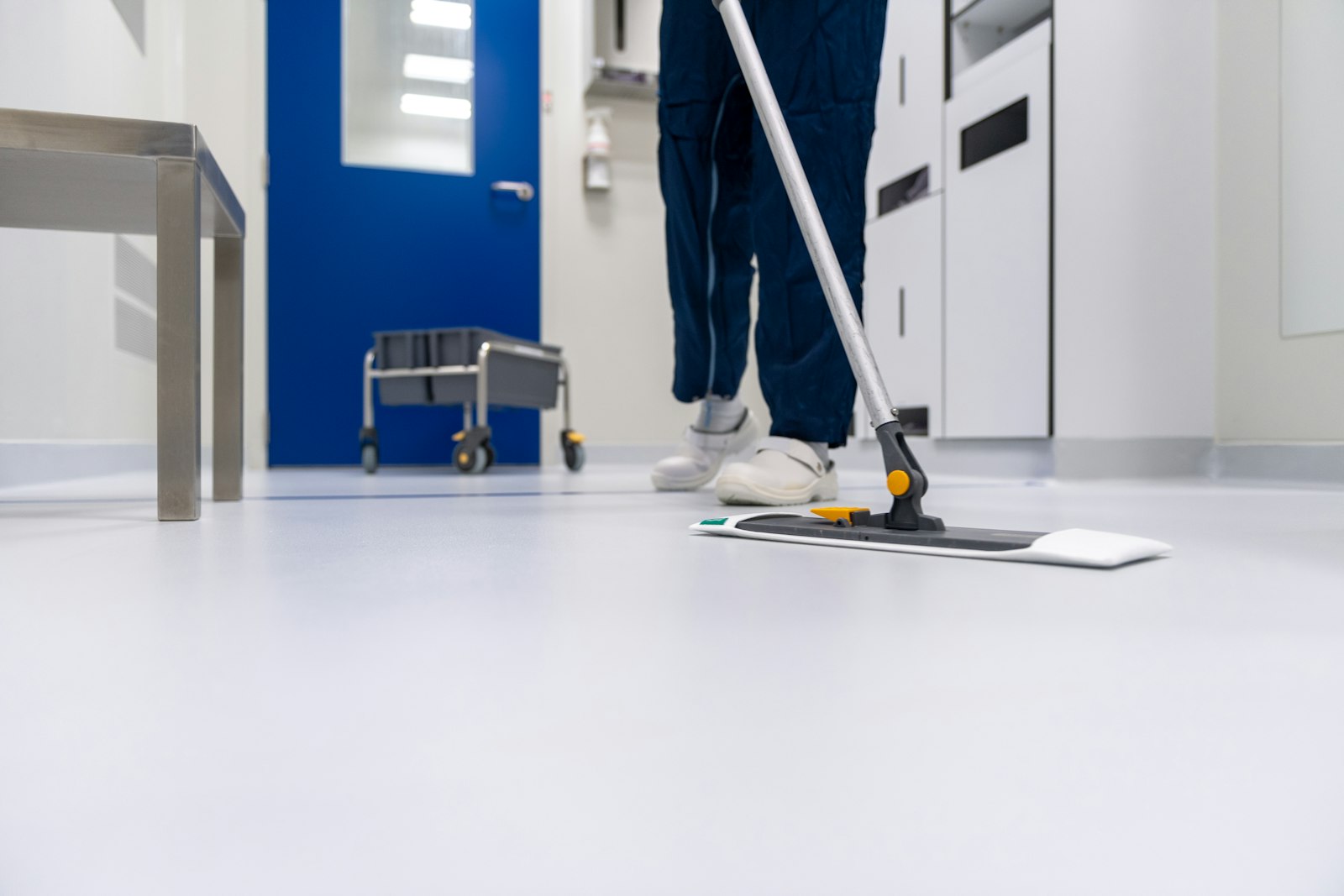
A flat mop spreads its pad across a broad contact area and is easy to change between tasks. Compare head size with the spaces you clean: an open corridor and a small bathroom present different access problems.
- Edco Duop All In One Set: our pick for flexibility and quality. It has three interchangeable heads from 15cm to 36.5cm wide, cleaning, scourer and glass pads for each size, a telescopic handle from 90cm to 155cm and a 65cm handle for close work. It is listed for floors, walls, benches, glass and bathrooms. Keep the scourer pad off delicate finishes.
- Oates and Sabco flat mop systems, such as the Oates Ultra Flat Mop 400mm, which has an extendable handle, a swivel head and hook-fastener tabs to hold the pad. Browse flat mops and replacement pads.
For rough or gritty floors
Rough concrete and textured ceramic tile can tear up a traditional cotton or microfibre mop head. For these surfaces we recommend the Rubbermaid rough wet mop head, built to withstand rough surfaces, on a clamp-style handle that grips a 5 inch headband and makes swapping a worn head quick.
For smaller spaces: a spin mop
Where the mopping area is small, such as a unit, a small office or a bathroom, we also recommend a spin mop, particularly the White Magic Duo Spin Mop Set. Customers love it for small areas. The hand or foot press spins the microfibre head to control how wet it is, so there is no wringing by hand and it is less physically demanding. Getting the head to the right dampness helps you avoid streaks and leave the floor clean. A replacement spin mop head is available.
Colour-code mops and buckets by area
Colour coding gives each area of a building its own mop, bucket, handle and cloths, so equipment used in a toilet never ends up in a kitchen. It is how cleaners stop germs and dirt being carried from one area into another. Most Australian workplaces use the same four colours.
| Colour | Where it is used |
|---|---|
| Red | Toilets, urinals, bathrooms and showers, the highest-risk areas |
| Yellow | Isolation and infectious areas in healthcare. Many other sites use yellow for washroom basins, sinks and mirrors, keeping red for toilets |
| Blue | General, low-risk areas such as offices, corridors, classrooms and reception |
| Green | Kitchens, cafes, bars and food preparation areas |
Keeping the colours separate matters most where contamination has real consequences. In hospitals and other healthcare settings, colour-coded equipment is part of cleaning and infection control guidance, and some hospitals add white for clinical areas such as operating theatres. Food businesses are required to keep food areas clean and free from contamination, and a green-only kitchen kit is the simplest way to show that toilet equipment never goes near food. Aged care, childcare centres, schools, gyms, hotels and cafes use colour coding for the same reason.
The Sabco round mop, the contractor handle and the Edco bucket each come in several of these colours, and you can browse our full colour-coded range. We will publish a more detailed guide to colour-coded cleaning soon.
In a workplace, put a colour-coding and dilution wall chart where the mops are filled. Existing Floormaster customers can get one free by emailing support@floormaster.com.au.
Keep grit and dirty mops out of the process
Sweep, vacuum or dust mop before you mop. Loose grit dragged under a wet mop can scratch the finish, and it turns your mop water dirty much faster.
Change the water when it turns grey rather than spreading soil back across the floor. On timber and laminate, wring the mop well, and never leave a wet mop standing on the floor when you have finished.
Sabco microfibre mops are machine washable, so keep a spare mop head in rotation while one is in the wash.
If you are unsure, contact Floormaster with the floor details and a description of the problem. A mop for daily dust and footprints may not solve a build-up that needs a different cleaning process.
Frequently asked questions
Can I use one mop on every floor in the building?
Only where the mop, cleaner and method suit each surface, and even then we recommend a separate colour-coded mop and bucket for each area. Check the care instructions for every floor type.
What do the mop and bucket colours mean?
Red is for toilets and bathrooms, yellow for isolation or infectious areas in healthcare (and washroom basins on many other sites), blue for general low-risk areas, and green for kitchens and food areas.
What is the difference between cotton, microfibre and polyester mop heads?
Microfibre picks up the most dirt per pass and is machine washable. Cotton is hardwearing and absorbent for everyday mopping with a bucket. Polyester, usually blended with cotton, is for applying sealer and polish, not routine cleaning.
What mop should I use on rough concrete or textured tile?
A standard cotton or microfibre head can tear on rough surfaces. Use a mop head built for rough floors, such as the Rubbermaid rough wet mop head, on a clamp-style handle so you can replace the head easily.
Does microfibre mean I can clean without detergent?
Sabco’s microfibre round mop can be used with or without chemicals, but for everyday mopping we recommend a pH-neutral cleaner such as Supastar. The soil, surface and required result determine the method.
Can I put a microfibre mop in the washing machine?
Yes. Sabco microfibre mops are machine washable, which is one reason we recommend them. Keep a spare head so you always have a clean one ready.
What should I use for heavy soiling or grease?
A pH-neutral cleaner is for everyday mopping. Heavy soiling, built-up grime and degreasing need a different product. Tell us the floor type and what you are trying to remove, and we will recommend one.
What should I bring when asking for advice?
Bring the flooring product name or care sheet if available, a photo, the approximate area and the name of your current cleaner. Tell us whether the issue is daily dirt, streaking, a sticky film or soil in textured areas.